Open for Work, Powered by Claude Code, and Introducing Intervu 🎙️

Hiiiiiii again! 👋
You probably saw my recent post and guessed it — yes, I'm open for work once again! If you're a recruiter or hiring manager who stumbled upon this, hi! I'm Aldrick, a Full-Stack Engineer and DevOps specialist who runs his own datacenter at home for fun. If that doesn't tell you enough about me, I don't know what will 😆
I'm actively looking for new opportunities and challenges to further sharpen my full-stack engineering and DevOps skills. Whether it's building scalable infrastructure, shipping production-ready apps, or automating everything in sight — I'm your person.
→ Let's connect on LinkedIn! Or I might be reaching out to you first. Fair warning 😎
The Claude Code Era
Now, let me share something that's been a game-changer for me recently. I've been using three AI coding tools in my daily engineering: Cursor, OpenCode, and Claude Code. No bias here — I genuinely use all three. But I have to be honest...
Claude Code has me the most impressed.

There's something about how it understands context, reasons through complex problems, and actually builds things end-to-end that sets it apart. It's not just autocomplete on steroids — it's like having a senior engineer pair-programming with you 24/7.
TESTCODER × Claude Code = 🤯
But here's where it gets really good. My TESTCODER — my self-hosted remote development environment running on my Proxmox cluster — has never been better since I integrated Claude Code into it.
And with the Coder Agent API, I can confidently tackle multiple workspaces at the same time. The real-time reporting of the AI's status across workspaces? Chef's kiss. It's like downloading the Claude mobile app and enabling the Dispatch feature — but better. Because it's my infrastructure, my servers, my control.
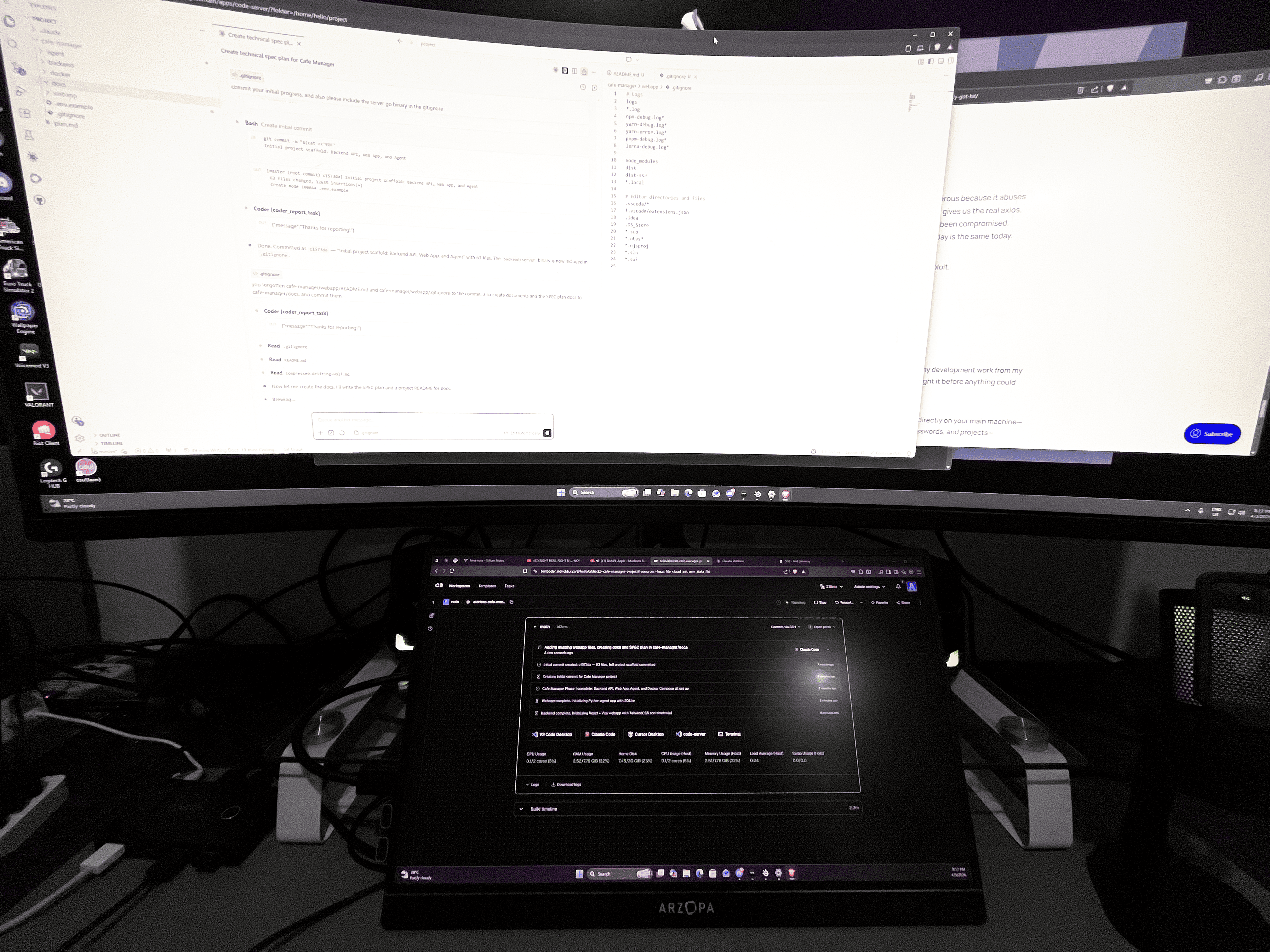
Look at that beauty. Multiple AI agents working across multiple workspaces, all reporting back in real-time. This is what efficient system development looks like. No more context-switching between terminals. No more "which workspace was I in again?" The Agent API keeps me informed of every agent's progress across all my active workspaces. It's like having a team of engineers — except they don't need coffee breaks ☕
Coding on the Go — iPad Edition
And when I'm not at my desk? Coding on my iPad has never been better. Seriously.
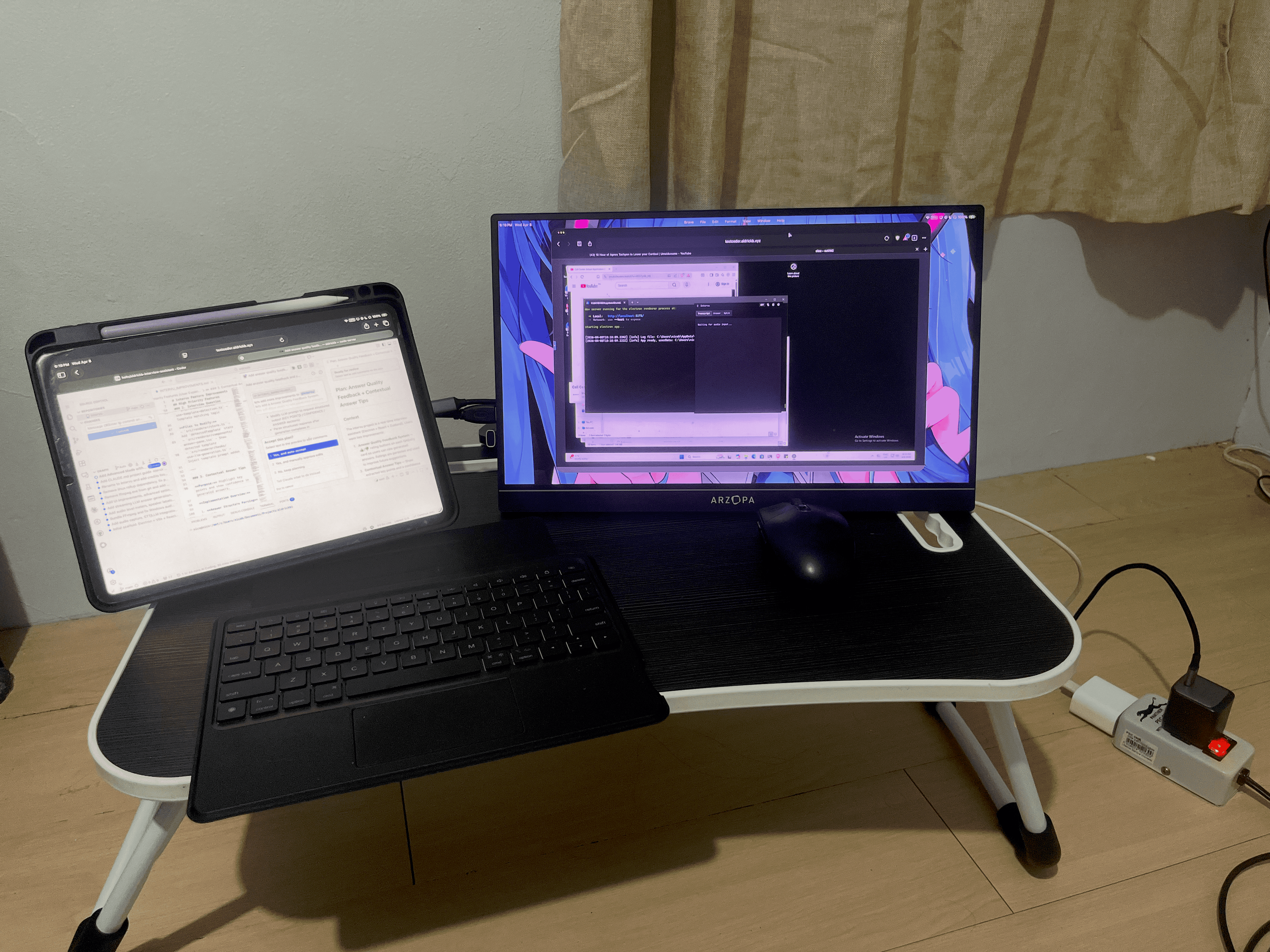
That's me, coding a full desktop application... from an iPad. In 2026. If you told me this three years ago, I'd laugh you out of the room.
The combination of TESTCODER + Claude Code means I'm never disconnected from my development environment. Whether I'm at a coffee shop, waiting for an appointment, or just chilling outdoors — my workspaces are a tap away, and Claude Code keeps the momentum going even when I'm on a tablet.
And That Brings Me to Intervu 🎙️
Remember how I said I was coding a full desktop application from my iPad? This is that application.
Let me introduce you to Intervu — my latest project. A real-time interview assistant powered by AI.
The Premise
Here's the thing: AI has accelerated engineering and coding tasks dramatically. We use AI to write code, debug, architect systems, automate deployments — the list goes on. So why not use AI for interviews too?
There are AI agents that help you with your daily life — scheduling, writing emails, planning trips. Me creating Intervu is... probably not illegal 😂
"But Isn't That Cheating?"
Let me address the elephant in the room.
No, it's not.
We're already in the age of AI, in a fast-paced industry that moves at breakneck speed. Companies are using AI to screen resumes. They're using AI to evaluate candidates. They're using AI-powered assessment platforms to test you. They ARE using AI. So let me level up too.
My personal take? I've applied for a lot of opportunities recently. Almost all of them use AI to evaluate me already. Whether it's automated coding assessments, AI-proctored interviews, or algorithmic resume screening — the other side is already AI-powered. Intervu is me leveling the playing field.
And honestly? Using Intervu is not cheating — it's showing a portion of my engineering capabilities. It demonstrates:
- AI adaptation — I can build with AI, not just use it
- Engineering skills — This is a full desktop application with real-time audio processing, STT pipelines, and LLM integration
- DevOps flex — I run my own servers at home, running AI and ML services. Not everyone can say that
Why I Built It Myself
Here's the truth — there are already AI interview assistants out there. I looked. But none of them matched what I needed:
- 💸 They cost money — Monthly subscriptions for something I can build myself? Nah.
- 🔒 Privacy? Gone — Your interview audio gets sent to some random cloud server. Hard pass.
- 🏠 I want to use my own servers — I already have AI servers running Ollama, Whisper, and various models at home. Why not use them?
I have my own homelab running AI and ML services 24/7. I built that infrastructure. I maintain it. So why would I pay someone else to process my data on their servers when I can do it myself — faster, cheaper, and with complete privacy?
Intervu captures system audio and microphone simultaneously, transcribes speech in real-time using Whisper, and generates suggested answers via your own LLM endpoint. Everything runs locally. Your data never leaves your machine. No cloud, no subscriptions, no privacy trade-offs.
I Built This on an iPad. Imagine What I Do on a Full Desktop.
This is the part I love the most. Intervu — a production-ready Electron desktop app with real-time audio processing, dual-stream transcription, and AI-powered answer generation — was built partly while coding on an iPad through TESTCODER.
If I can ship that from a tablet... what more can I do with my full workstation? A MacBook Pro? A desktop with triple RTX 3060s? 🚀
The answer: a lot more. And I'm just getting started.
The Full Story
Want to know more about the philosophy behind Intervu? I wrote about it in detail — the inspiration, the two types of candidates in this industry, and why self-hosted matters.
→ Read the full story on the Intervu docs
And if you want to try it yourself:
→ Download Intervu from GitHub